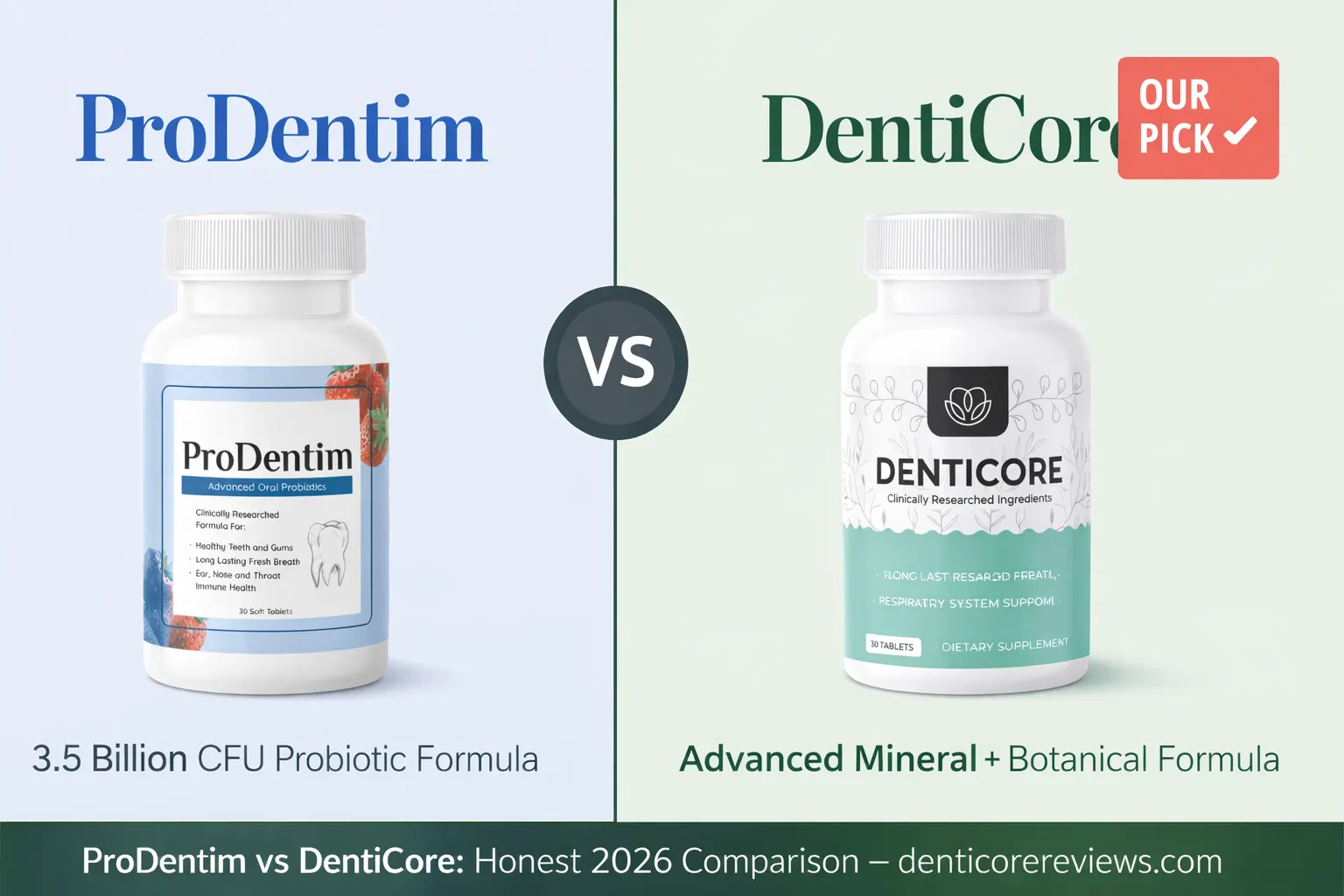
What is ProDentim?
ProDentim is an oral probiotic supplement sold as a soft, chewable tablet. Its stated idea is that everyday habits — antibiotics, some mouthwashes and a modern diet — can deplete the helpful bacteria in your mouth, and that replacing them can support gum comfort and fresher breath. Each serving is marketed as providing 3.5 billion CFU from clinically studied probiotic strains such as Lactobacillus paracasei, Lactobacillus reuteri and B. lactis BL-04, alongside supporting ingredients like inulin (a prebiotic), malic acid and peppermint. Published counts of the exact number of strains vary between sources, so we describe the formula rather than fixing a single number.
ProDentim is sold through its official website and is made in an FDA-registered, GMP-certified facility in the United States. Like all dietary supplements, it is not FDA-approved (the FDA does not approve supplements) and it is not a treatment for any dental disease.
What is DentiCore?
DentiCore is a soft, chewable dental-health supplement associated with Dr. Norbert Miles in its marketing. Its central claim is different from ProDentim's: rather than adding probiotics, DentiCore's makers say the root issue behind many gum problems is insufficient oxygen reaching gum and tooth tissue, and that the formula helps improve that oxygen flow while clearing bacteria from the mouth and airways. That oxygenation story is a marketing explanation, not an independently established medical finding — we cover what is and isn't verifiable in the evidence section below.
According to the official DentiCore website, the formula is built from seven natural ingredients — shilajit, peppermint, fulvic acid, chlorophyllin, chlorella, boron citrate complex and copper — delivered in a chewable tablet, made in an FDA-registered, GMP-certified US facility. It is sold only through the official website (not on Amazon or in stores) and, like ProDentim, is not FDA-approved and is not a treatment for gum disease or tooth decay.
DentiCore vs DentiCore Max: don't confuse the two
Before comparing formulas, it's worth clearing up a common mix-up, because search results blur these together. The DentiCore discussed on this page — the chewable, oxygenation-focused formula tied to Dr. Norbert Miles — is not the same as "DentiCore Max," a separately branded product sold on marketplaces like Amazon.
- DentiCore (official): a soft chewable tablet, botanical- and mineral-based, built around the oxygen-flow claim, sold only on its official website.
- DentiCore Max (marketplace): a different product — sold as capsules and marketed as a high-CFU oral probiotic (advertised around 40 billion CFU) with added vitamins, zinc and collagen. Despite the similar name, it is a distinct formula from a different seller.
Similarly named products such as DentPure/DentiPure also appear in the same searches. If you're comparing against ProDentim, make sure you're looking at the original DentiCore chewable — checking the official website is the simplest way to confirm you have the right product and are covered by its refund terms.
How ProDentim and DentiCore differ
The clearest way to think about the prodentim vs denticore choice is by mechanism. ProDentim is a bacterial-balance play: it adds live probiotic strains in the hope of shifting the oral microbiome over time. DentiCore is a botanical-and-mineral play built around an oxygen-flow idea; it is not designed primarily to add bacteria to your mouth.
That difference flows through everything else. ProDentim leads with a measurable probiotic dose (3.5 billion CFU) and strain names you can look up. DentiCore leads with plant and mineral ingredients and does not publish a CFU count, because CFU isn't the point of its formula. Both come as chewable tablets, both are made in FDA-registered US facilities, and both carry a 60-day money-back guarantee — so the meaningful decision is about ingredients and goals, not packaging.
Ingredients: ProDentim vs DentiCore
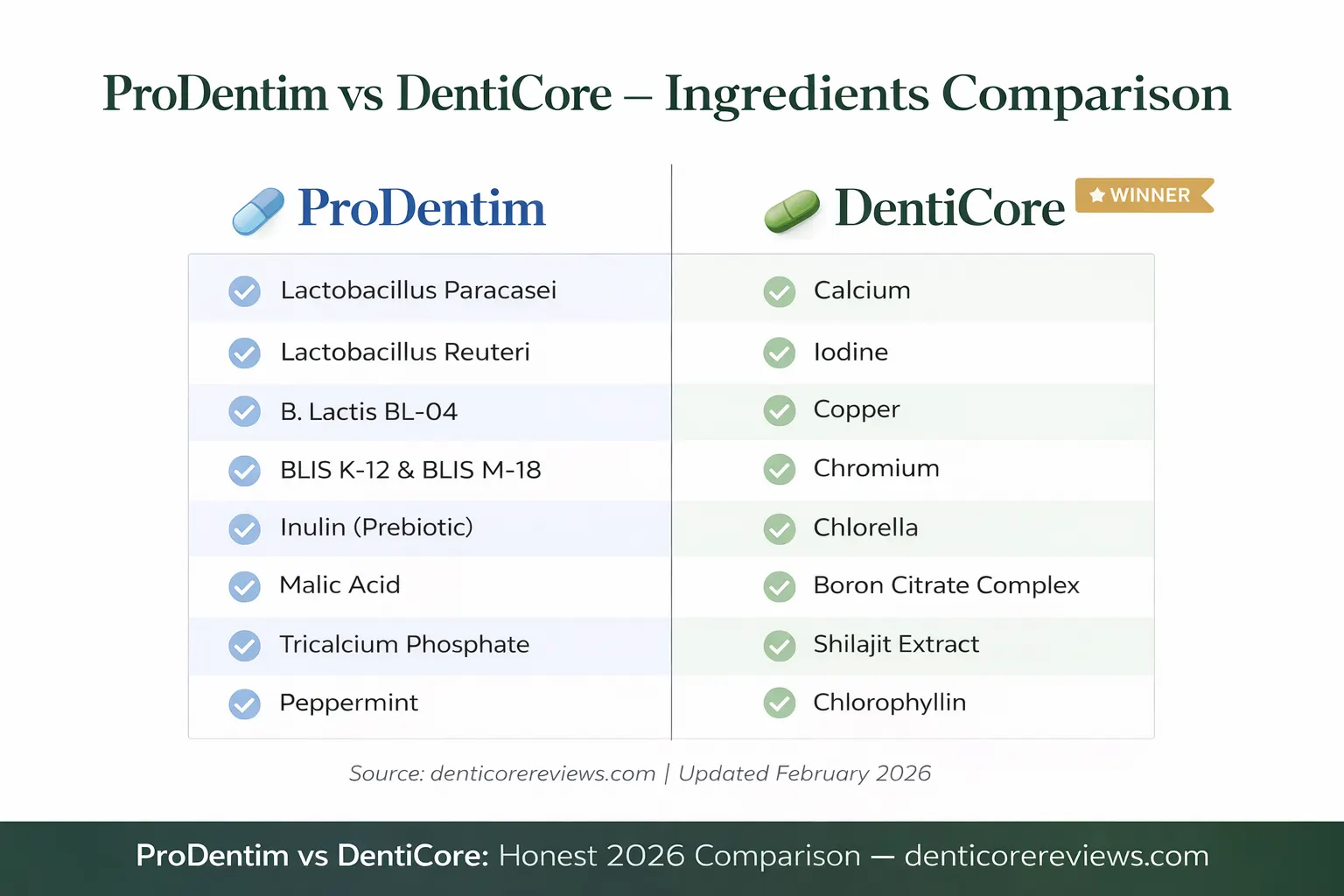
ProDentim is built around probiotic strains; DentiCore is built around botanicals and minerals.
ProDentim ingredients
ProDentim's formula is probiotic-first, with supporting plant and mineral ingredients:
- Probiotic strains — including Lactobacillus paracasei, Lactobacillus reuteri and B. lactis BL-04, delivering 3.5 billion CFU. Several of these strains appear in oral-microbiome research.
- Inulin — a prebiotic fibre that acts as food for the probiotic strains.
- Malic acid — a plant acid marketed for surface-stain support.
- Peppermint — included for breath freshness.
DentiCore ingredients
The official DentiCore website lists seven natural ingredients, weighted toward botanicals and minerals:
- Shilajit — a mineral-rich resin the makers say supports circulation.
- Peppermint — included for the respiratory/breath angle.
- Fulvic acid — marketed for nutrient absorption.
- Chlorophyllin — a chlorophyll derivative used as an internal deodorizer.
- Chlorella — a green algae included for its nutrient profile.
- Boron citrate complex — a boron source marketed for gum-tissue and mineral support.
- Copper — a trace mineral included for its antibacterial reputation.
A quick note on accuracy: some third-party pages list DentiCore as containing calcium, iodine or chromium. The current official ingredient list above does not include those, so we've followed the manufacturer's own list. Ingredient panels can change between production runs, so always confirm against the label on the bottle you receive.
Probiotics and CFU: where they diverge
This is the single biggest practical difference. If you specifically want an oral probiotic with a defined dose, ProDentim is the product built for that job — it states 3.5 billion CFU and names its strains. DentiCore does not publish a CFU count and is not marketed primarily as a probiotic, so comparing the two on CFU alone isn't apples-to-apples. Chlorella and chlorophyllin in DentiCore are plant ingredients, not probiotic bacteria. If probiotic dosing is your priority, that points to ProDentim; if you're drawn to the botanical/mineral, oxygen-flow approach, that points to DentiCore.
What the evidence actually shows
Supplement marketing often blurs different kinds of "evidence." It helps to separate them, because they carry very different weight:
- Ingredient-level evidence. Some individual ingredients have published research — for example, certain probiotic strains in ProDentim have been studied for oral-health outcomes, and the American Dental Association recognizes that oral-microbiome balance is linked to gum health. This supports ingredients, not any specific finished product.
- Formulation claims. How ingredients are combined and dosed in a given product is a manufacturer decision. A useful ingredient at a research dose is not the same as that ingredient at an unknown dose inside a proprietary blend.
- Finished-product evidence. We could not find independent, peer-reviewed clinical trials of ProDentim or DentiCore as finished products. Neither has published that level of evidence, so product-level effectiveness claims rest largely on marketing and self-reported reviews.
- Marketing claims. Statements like "eliminates airway bacteria," "rebuilds teeth," or dramatic before/after stories are promotional. DentiCore's "oxygen-flow" origin story and any "rebuild your teeth" language fall here — treat them as marketing, not established science.
- What can't be verified. Specific star ratings, review counts, and success percentages quoted in ads are generally not independently auditable. We don't repeat those numbers as fact.
Bottom line: both products contain ingredients with some individual research behind them, but neither has independent clinical proof as a finished supplement. That's normal for this category — just keep expectations realistic and rely on your dentist for actual treatment.
Side effects and safety
Both are marketed as natural, non-GMO and made in FDA-registered facilities, and serious side effects are not commonly reported for either. The most frequently mentioned adjustment effect for probiotic products like ProDentim is mild, temporary digestive upset (such as gas or bloating) when starting. For ingredient-based formulas like DentiCore, occasional reports include mild digestive changes or mouth dryness early on. As with any supplement, an allergy or sensitivity to a specific ingredient is possible.
This is general information, not medical advice. If you are pregnant or nursing, under 18, taking medication, or managing a health condition, talk to your doctor or dentist before starting either product.
Is each one legit, and where should you buy?
Both ProDentim and DentiCore are real products from businesses that sell online with a stated 60-day money-back guarantee, so a purchase can typically be refunded within that window. "Legit" in that transactional sense is reasonable for both. The fair caution is the same for each: the marketing tends to promise more than the evidence supports, so read effectiveness claims skeptically.
Both are sold through their own official websites rather than major retailers. For DentiCore in particular, buying through the official website is the way to make sure you get the original chewable formula (not the separate "DentiCore Max" capsule product) and remain eligible for the refund guarantee. You can read our fuller DentiCore review for more on the product itself.
Which one may fit you?
There's no universal "better" here — it depends on what you're actually looking for:
ProDentim may fit if you…
- Specifically want an oral probiotic with a defined CFU dose
- Prefer a formula built around named, researchable probiotic strains
- Are focused on longer-term oral-microbiome balance
DentiCore may fit if you…
- Prefer a botanical- and mineral-based approach over probiotics
- Are drawn to its oxygen-flow, whole-mouth positioning
- Want a single chewable rather than a probiotic dose
Whichever you lean toward, the 60-day guarantee on both means you can try one and request a refund if it isn't right for you. And neither replaces brushing, flossing, and regular dental checkups.
Want to check current pricing, bundles and the refund terms on the original DentiCore chewable?
Visit the Official DentiCore WebsiteProDentim vs DentiCore: FAQ
Is DentiCore better than ProDentim?
Neither is universally "better" — they're different types of product. ProDentim is an oral probiotic; DentiCore is a botanical-and-mineral chewable built around an oxygen-flow idea. The right choice depends on whether you want a probiotic dose or a non-probiotic formula.
Is DentiCore the same as DentiCore Max?
No. DentiCore Max is a separately branded product (sold as capsules and marketed as a high-CFU probiotic with added vitamins) from a different seller. The DentiCore compared here is the original chewable formula sold on the official DentiCore website.
Can I take DentiCore and ProDentim together?
People sometimes combine supplements, but there's no established need to take both, and doing so adds cost. If you're considering stacking supplements, ask your dentist or doctor first.
Are they FDA-approved?
No. The FDA does not approve dietary supplements. Both are described as being made in FDA-registered, GMP-certified facilities, which is the applicable standard for supplements — but that is not the same as FDA approval or proof of effectiveness.
Where can I buy each one?
Both are sold through their own official websites rather than major retailers. Buying from the official site is also how you confirm you're getting the genuine product and the 60-day refund terms.
* These statements have not been evaluated by the Food and Drug Administration. These products are not intended to diagnose, treat, cure, or prevent any disease. Individual results may vary. This article contains affiliate links; we may earn a commission if you purchase through our links at no additional cost to you.